From A to I: Solving Regional Artwork
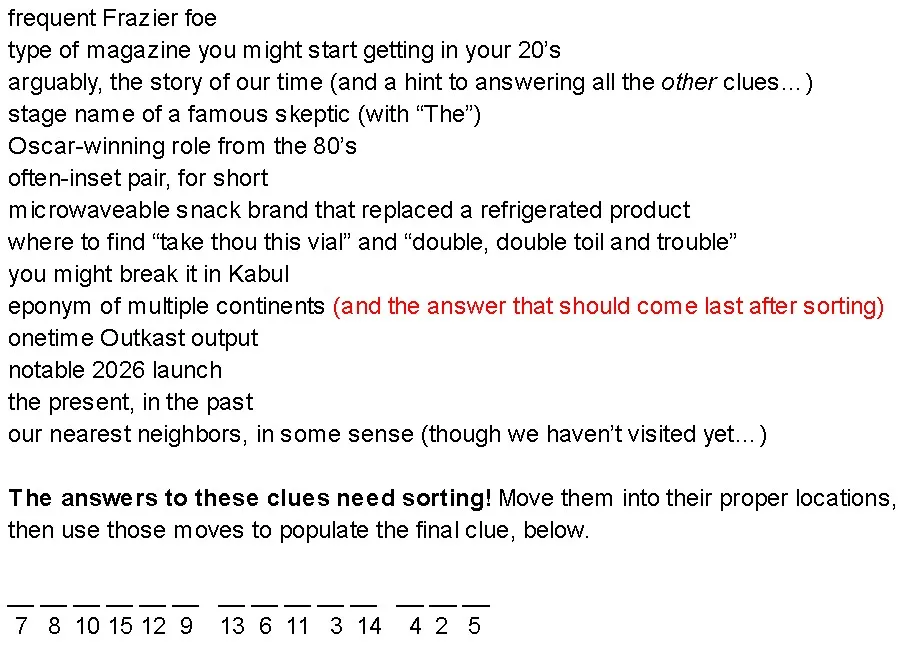
Jane Street’s June 2026 puzzle gives fourteen clues whose answers need to be sorted. I initially treated them as independent crossword-style clues. The title was not much help either. Regional Artwork could point to almost anything. The useful pattern only appeared after I had a few answers in hand.
The solving process
I started with the clue about “our nearest neighbors.” The note that we have not visited them yet points to Alpha Centauri, the nearest stellar system to our own. After that, I worked through a few of the more distinctive clues:
- The famous skeptic is James Randi, whose stage name is The Amazing Randi. The answer needed to be Amazing Randi, without the leading “The.”
- The notable 2026 launch is Artemis II. I first wrote “Artemis 2,” but the Roman-numeral spelling turned out to be important for the answer’s exact length.
- The Shakespeare quotation points to Act IV, Scene I of Macbeth. Again, the Roman numerals matter.
- The eponym of multiple continents is Amerigo Vespucci. This was the one I had to look up; I recognized the name once I had the clue’s wording in front of me.
At that point I noticed that all four answers start with A and end with I. That turned out to be the central hint. The third clue, “arguably, the story of our time,” then becomes the almost comically direct answer AI.
Once I had that pattern, the remaining clues became much easier to search. The one-time Outkast output is Aquemini, which is Outkast’s only album beginning with A and ending with I. A microwaveable popcorn brand that replaced a refrigerated product is ACT II. The frequent Frazier foe is Ali, referring to Muhammad Ali.
The “often-inset pair” took a little more lateral thinking. Maps commonly show Alaska and Hawaii in inset boxes, so “for short” gives AK & HI. For the Oscar-winning role from the 1980s, I found “Salieri” first in a crossword answer bank. The full answer that fits the pattern is Antonio Salieri, the character played by F. Murray Abraham in Amadeus.
The clue about Kabul refers to a currency. An afghani is Afghanistan’s currency, so in Kabul you might break one in the ordinary sense of breaking a bill. That left the two clues I found least familiar. By then I had run out of useful search terms, so I asked Claude for ideas. It suggested Alumni for the magazine clue, which made complete sense, but my university has never sent me an alumni magazine so the idea never crossed my mind.
It also suggested Anno Domini for “the present, in the past.” That one made me feel a little stupid. The present year is still labeled AD, but AD also describes all the years stretching back into the past. Once I saw it written down, the clue seemed obvious. I just had not made the connection myself.
I did not solve these in clue order. A few recognizable answers suggested the spelling constraint, and that constraint gave me a way to search for the stranger ones. Here are all of the answers in the intended order:
| # | Clue | Answer |
|---|---|---|
| 1 | Frequent Frazier foe | Ali |
| 2 | Type of magazine you might start getting in your 20s | Alumni |
| 3 | Arguably, the story of our time (and a hint to answering the other clues) | AI |
| 4 | Stage name of a famous skeptic (with “The”) | Amazing Randi |
| 5 | Oscar-winning role from the 80s | Antonio Salieri |
| 6 | Often-inset pair, for short | AK & HI |
| 7 | Microwaveable snack brand that replaced a refrigerated product | ACT II |
| 8 | Where to find “take thou this vial” and “double, double toil and trouble” | Act IV, Scene I |
| 9 | You might break it in Kabul | Afghani |
| 10 | Eponym of multiple continents (and the answer that should come last after sorting) | Amerigo Vespucci |
| 11 | One-time Outkast output | Aquemini |
| 12 | Notable 2026 launch | Artemis II |
| 13 | The present, in the past | Anno Domini |
| 14 | Our nearest neighbors, in some sense (though we haven’t visited them yet) | Alpha Centauri |
The punctuation and typography in the answers are part of the sorting mechanism, so I kept the intended forms above even though they will be normalized shortly. In particular, AK & HI, ACT II, and Act IV, Scene I should not be treated as ordinary words with arbitrary punctuation removed by eye.
Sorting the answers
The puzzle says to move the answers into their proper locations. I interpreted that as sorting them by length after removing spaces and punctuation. The result confirms the idea: the normalized lengths are all different, and they cover every value from 2 through 15.
I used a short Python script to make the normalization explicit rather than counting characters manually:
import re

answers = [
    "Ali",
    "Alumni",
    "AI",
    "Amazing Randi",
    "Antonio Salieri",
    "AK & HI",
    "ACT II",
    "Act IV, Scene I",
    "Afghani",
    "Amerigo Vespucci",
    "Aquemini",
    "Artemis II",
    "Anno Domini",
    "Alpha Centauri",
]

def normalize(answer):
    """Keep letters only, preserving Roman numerals such as II."""
    return re.sub(r"[^A-Z]", "", answer.upper())

normalized = [normalize(answer) for answer in answers]
sorted_answers = sorted(
    enumerate(normalized, start=1),
    key=lambda clue_and_answer: len(clue_and_answer[1]),
)

for sorted_position, (clue_number, answer) in enumerate(sorted_answers, start=1):
    print(sorted_position, clue_number, answer, len(answer))
The sorted output starts with AI, then ALI, AKHI, and ACTII, and ends with AMERIGOVESPUCCI. The complete ordering is:
| Answer | Normalized form | Length |
|---|---|---|
| AI | AI | 2 |
| Ali | ALI | 3 |
| AK & HI | AKHI | 4 |
| ACT II | ACTII | 5 |
| Alumni | ALUMNI | 6 |
| Afghani | AFGHANI | 7 |
| Aquemini | AQUEMINI | 8 |
| Artemis II | ARTEMISII | 9 |
| Anno Domini | ANNODOMINI | 10 |
| Act IV, Scene I | ACTIVSCENEI | 11 |
| Amazing Randi | AMAZINGRANDI | 12 |
| Alpha Centauri | ALPHACENTAURI | 13 |
| Antonio Salieri | ANTONIOSALIERI | 14 |
| Amerigo Vespucci | AMERIGOVESPUCCI | 15 |
With the sorted list in hand, I compared each answer’s original clue position with its new position. The absolute difference is the number of places that answer moved. That number is also a character index into the answer. Since Python uses zero-based string indices, the character at move count n is answer[n - 1].
sorted_position_by_clue = {
    clue_number: sorted_position
    for sorted_position, (clue_number, answer) in enumerate(sorted_answers, start=1)
}

rows = []
for original_position, answer in enumerate(normalized, start=1):
    sorted_position = sorted_position_by_clue[original_position]
    places_moved = abs(sorted_position - original_position)
    extracted_letter = answer[places_moved - 1]

    rows.append({
        "clue": original_position,
        "answer": answer,
        "length": len(answer),
        "sorted_position": sorted_position,
        "places_moved": places_moved,
        "letter": extracted_letter,
    })

for row in rows:
    print(
        row["clue"], row["answer"], row["length"],
        row["sorted_position"], row["places_moved"], row["letter"],
    )
Here is the same calculation as a table, kept in the original clue order:
| Clue | Answer | Sorted position | Positions moved | Extracted character |
|---|---|---|---|---|
| 1 | ALI | 2 | 1 | A |
| 2 | ALUMNI | 5 | 3 | U |
| 3 | AI | 1 | 2 | I |
| 4 | AMAZINGRANDI | 11 | 7 | G |
| 5 | ANTONIOSALIERI | 13 | 8 | S |
| 6 | AKHI | 3 | 3 | H |
| 7 | ACTII | 4 | 3 | T |
| 8 | ACTIVSCENEI | 10 | 2 | C |
| 9 | AFGHANI | 6 | 3 | G |
| 10 | AMERIGOVESPUCCI | 14 | 4 | R |
| 11 | AQUEMINI | 7 | 4 | E |
| 12 | ARTEMISII | 8 | 4 | E |
| 13 | ANNODOMINI | 9 | 4 | O |
| 14 | ALPHACENTAURI | 12 | 2 | L |
For example, ALI moves from position 1 to position 2, so we take its first character: A. AMAZINGRANDI moves from position 4 to position 11, so we take its seventh character: G.
The answer lengths label the blanks in the final clue. The numbers printed under the blanks are therefore lengths, not clue numbers. A final few lines of Python reproduce the extraction in that displayed order:
final_clue_labels = [7, 8, 10, 15, 12, 9, 13, 6, 11, 3, 14, 4, 2, 5]
letter_by_length = {row["length"]: row["letter"] for row in rows}

message = "".join(letter_by_length[length] for length in final_clue_labels)
print(message)
# GEORGELUCASHIT
Reading the result with the spaces shown by the puzzle,
7  8  10  15  12  9    13  6  11  3  14    4  2  5
G  E  O   R   G   E    L   U  C   A  S     H  I  T
we get:
GEORGE LUCAS HITThe final clue asks for a George Lucas hit. The only George Lucas film that starts with A and ends with I is American Graffiti.
That also explains the title: American Graffiti is the regional artwork.
What made this one fun for me was the way the clues kept changing character. At first, Alpha Centauri and Amazing Randi felt like isolated bits of trivia. Once I noticed the A-to-I pattern, even oddities like ACT II and afghani became plausible answers. The final sort was the payoff: it turned that arbitrary-looking list into “George Lucas hit,” with American Graffiti as the answer. That felt a little different from the usual Jane Street puzzle, and I liked it.
Final answer: American Graffiti