Solving Andy's Afternoon Amble Puzzle
The puzzle
Jane Street’s August 2026 puzzle brings back Andy the ant. He’s moved off his old soccer ball and now lives on a truncated tetrahedron blown up into a sphere, which has four white hexagons and four black triangles. Andy is tiny and can’t see very well, so he doesn’t notice the curvature, and he stays off the black triangles because he suspects they’re bottomless pits.
Every afternoon he wakes up on a white hexagon, marks it as home with some pheromones, and goes for a random amble. Each step takes him to one of the three neighbouring white hexagons with equal probability, and he stops as soon as he first gets back home. He can recognize home by the pheromones, but he can’t tell which edge he came back across.
This afternoon the ball bounced through a kitchen with an infinite hexagonal tile floor. Every white tile on the floor is surrounded by alternating black and white tiles, and every black tile is surrounded by six white ones. Andy fell off, woke up on a white tile, didn’t notice that anything had changed, and went on his amble like usual. Throughout the walk he remembers the turns he’s taken. What is the probability that by the end of his amble, he’s worked out that he isn’t on the ball anymore?
My first thought
When I first read this, I figured Andy would notice almost straight away, since the two worlds look nothing alike once you draw which hexagons touch which. On the ball every hexagon touches the other three, so the graph is , while on the floor every white tile has three white neighbours and the tiles go on forever, which gives an infinite honeycomb.
Andy can’t see either graph, though. Every tile he stands on, ball or floor, gives him the same three doors in the same order around him, and all he has to go on is the list of turns he took. What I actually needed to figure out was whether that list ever tells him which world he’s in.
Labelling the floor
On the ball, a list of turns always lands Andy on one definite hexagon, since every hexagon touches every other one. If we call his home and the other three hexagons , , and , every list of turns spells out a walk on those four labels.
To compare the two worlds, I wanted to label the floor the same way, giving every white tile one of , , , or so that each tile has exactly one neighbour with each of the other three labels. With a labelling like that, a list of turns would land on the same label on the floor as it would on the ball.
Building one turned out to be easier than I expected, because the honeycomb’s edges only point in three directions. I gave each direction a tag (, , or ) and defined a tile’s label as the result of combining the tags along any path from home, where a tag combined with itself cancels to and two different tags combine to the third (so and make ).
This only works if the label doesn’t depend on which path you take to a tile. Every hexagonal loop in the honeycomb uses each direction twice, so walking around a loop cancels back to and any two paths to the same tile agree. From a tile labelled , the three neighbours are combined with , , and , which are exactly the three labels other than .
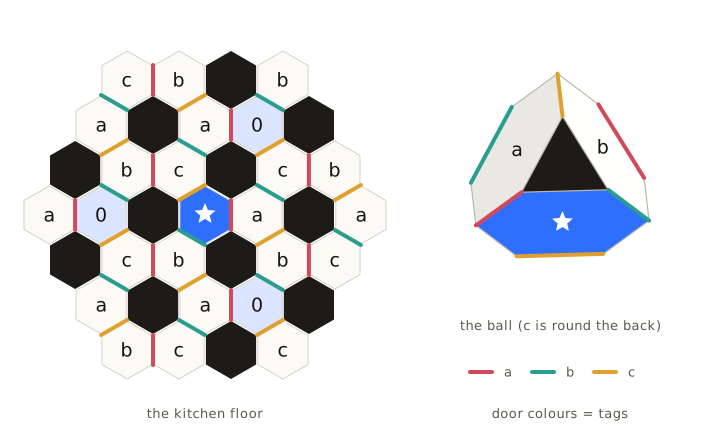 Every door is coloured by its tag, which is also what you get by combining the labels on either side of it. The starred tile is home, and while the floor has the same doors and labels as the ball, it has lots of 0-tiles and only one of them is home.
With this labelling, Andy’s list of turns traces out the same walk on whether he’s on the ball or the floor, and nothing seems off until that walk reaches and his turns tell him he should be home. On the ball he always is, but the floor has infinitely many -tiles and only one of them has his pheromones on it. If the first -tile he reaches is one of the others, he ends up somewhere his turns call home without any pheromones, so Andy stays fooled only if the first -tile he reaches is his real home.
The floor breaks into rings
Next I looked at what happens between Andy leaving home and reaching a -tile. Every tile that isn’t a has exactly one neighbour, so deleting all the -tiles takes one connection away from every other tile and leaves each of them with two. A graph where every vertex has two neighbours is a collection of separate loops, and on the floor those loops are six-tile rings around some of the pits.
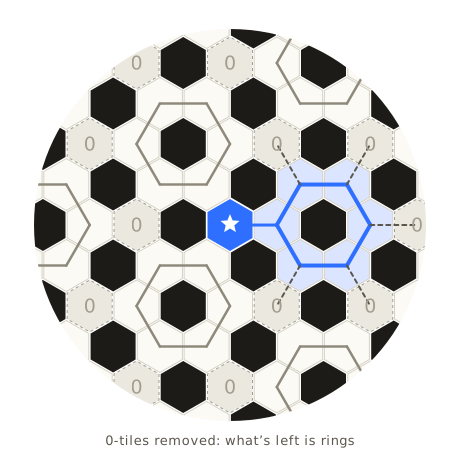 With the 0-tiles gone, every remaining tile sits on a six-tile ring. Andy’s ring is in blue, with one exit leading home and the other five (dashed) leading to decoy 0-tiles.
After his first step Andy is on one of these rings, and he stays on it until he steps onto a -tile. If we number the ring to with next to home, then on every step he goes one way around the ring, the other way, or out to that tile’s neighbour, each with probability . The exit from leads home, and the other five lead to decoys where his turns say he’s home but there are no pheromones.
Solving the ring
Let be the probability that Andy eventually leaves through his real home, starting from . Each is the average over his three options, and the only option with a fixed payoff is the exit from , which is worth . Using the ring’s symmetry about to set and leaves four equations:
I solved these from the far side of the ring. Since is directly opposite home and its exit is a decoy, , and plugging that into the line above gives and then . The first equation then only involves :
Andy starts out on , so he finds his real home with probability , and the probability that he works out he’s been moved is
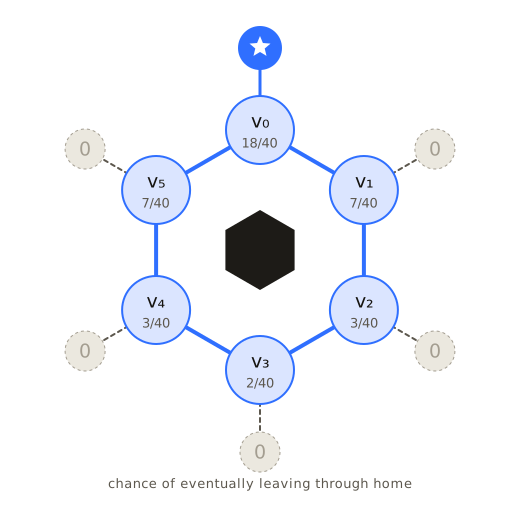 Each ring tile’s chance of eventually leaving through home, in 40ths.
Why it isn’t 5/6
With six exits and only one of them real, it’s tempting to guess , which would be right if Andy left the ring through a random exit. He’s much more likely to leave through the exits close to where he started, though. Starting from , he leaves through his real home of the time, through each of the next two exits of the time, then each, and through the one directly opposite only of the time. A lot of his escapes happen within his first step or two, before he’s had a chance to wander, which is why the answer comes out at instead of .
These are the same numbers as in the figure above, which surprised me until I realized the walk around the ring is symmetric, so the chance of getting from out through ‘s exit equals the chance of getting from out through ‘s.
A few other things I noticed
On the ball, Andy gets back home with probability on every step after his first, so his amble lasts steps. On the floor he leaves the ring with probability on every step after his first, so the time until his turns say he’s home has the same distribution, and timing his ambles for a year wouldn’t help him notice anything. Reaching a -tile that doesn’t smell like home is the only way he can find out.
The honeycomb is bipartite, so any walk that ends at Andy’s real home takes an even number of steps, whereas on the ball he can get home in an odd number. If his turns say he’s home after an odd number of steps, he has to be on a decoy, and that happens with probability , which gives without solving the ring at all. You still need the labelling to know which tiles count as home in the first place, though.
In topology terms, the floor is a covering space of the ball and the four labels form the Klein four-group, but I didn’t need any of that to get the answer. Everything I used came from every tile seeing each of the other three labels exactly once.